Polarity of Prominence
Seeking the Sands of Time — Complete Rulebook
Objective
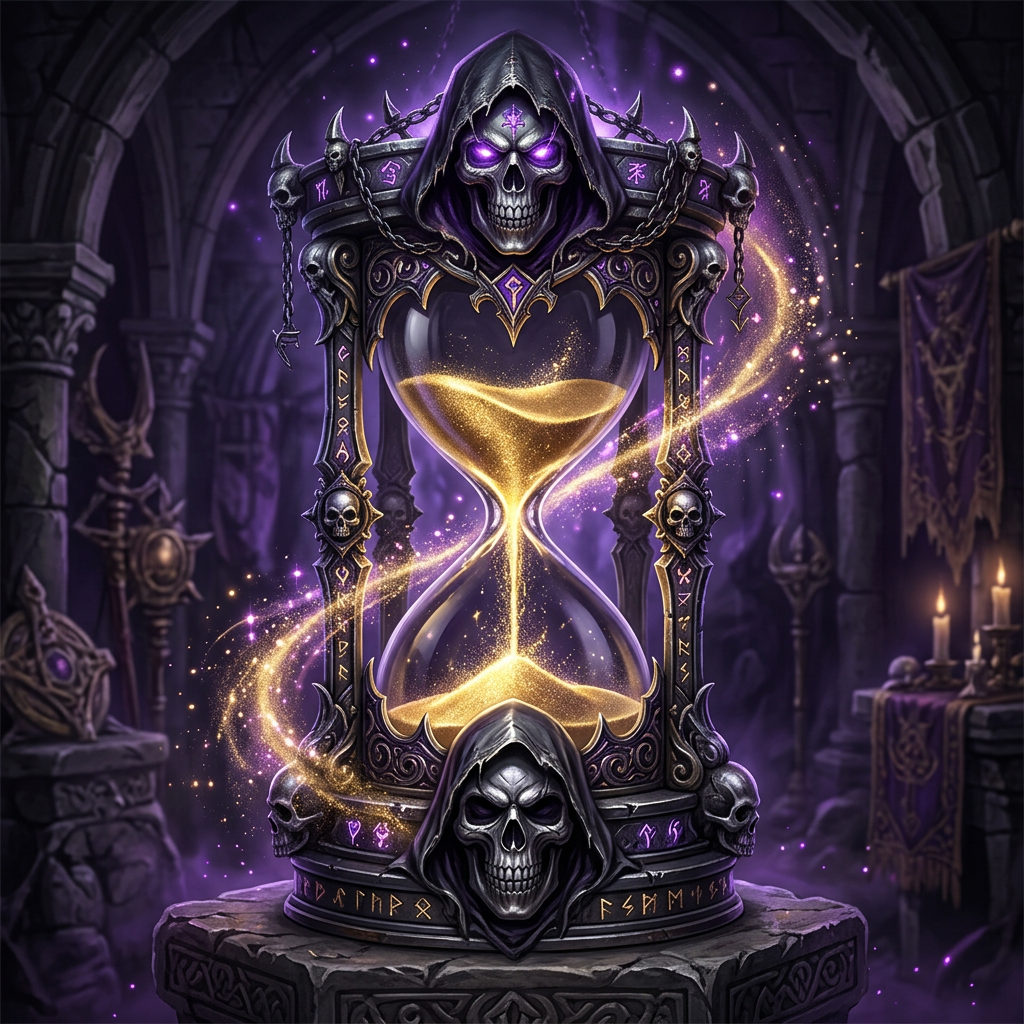
The ultimate goal of Polarity of Prominence is to capture the Grim Reaper's Sands of Time — the hourglass piece held at the center of the board. Four players (or AI teams) battle simultaneously, each trying to seize the Sands of Time while destroying the other three teams. You must be the last team standing — eliminate your opponents, outlast their strategies, and claim the Sands of Time to win.
⚠ This is NOT about capturing a King. Victory comes from claiming the Sands of Time and being the sole surviving force on the board.
Gameplay Overview
Polarity of Prominence is a 4-player game combining strategy and luck. Players take turns moving pieces on the board, trying to assign a protector to protect the sands of time, decimate opponents, and negotiate with the Grim Reaper to gain more time.
Additionally, 2-player chess is available in manual mode under the Human vs AI tab — allowing two human players to face off directly on the board without AI opponents.
Setup
Place the following pieces on the primary board:
- Rook pieces in each of the four corners
- Knight pieces next to each of the Rooks
- Bishop pieces next to each of the Knights
- Queen piece on her colored square
- King piece on the remaining square next to the Queen
- Pawn pieces in the second row in front of the other pieces
Moving Pieces
Assigning a Protector
A Protector piece is any piece that fortifies another piece in order to protect it from being captured. It does not matter how many pieces are used to back or protect the initial piece that may be in danger.
When a player moves a piece next to the Grim Reaper's Sands of Time, that piece is assigned as a Protector and the Sands of Time is automatically placed in check — signaling that player's intent to claim absolute power and challenge the Grim Reaper alone.
Each remaining player is then given one chance to place their own piece adjacent to the Sands of Time as a Gate Keeper — standing guard to prevent the initial player from claiming solo absolute power and authority to challenge the Grim Reaper unchallenged.
If multiple Gate Keepers are placed around the Sands of Time while it is already in check, each Gate Keeper holds their position as a guardian — standing guard and fending off any opposing players who attempt to remove them from their post. Gate Keepers must defend their position against all challengers. Unlike regular chess, a Gate Keeper does NOT need another piece to protect it — its position next to the Sands of Time grants it automatic guardian status. Players do not need to waste pieces guarding the Gate Keeper itself.
Once all opposing Gate Keepers have been defeated in combat, the last remaining Gate Keeper earns the right to challenge the Grim Reaper's Sands of Time alone — without any other piece to back them up. That final guardian then enters the Negotiation Phase to face the Grim Reaper.
Negotiating with the Grim Reaper
After claiming the Sands of Time, the winner enters the Negotiation Phase — the decisive test against the Grim Reaper. This entire process is your challenge to gain more time and secure true victory.
- Choose a balance number — the target your equation must equal.
- Click a Dice Tower — this opens the portal and starts the 10-minute hourglass.
- Click arithmetic dice ( +, −, ×, ÷ ) to build your equation's operators.
- Click number dice to fill in the numerical values and complete the equation.
- Submit when your equation balances — if it equals your chosen number, you WIN.
⚠ The Dice Tower only becomes available when you are the last team standing after defeating all other opponents.
Tip: You do not need to type an equals sign (=) in your equation — the system already knows your target number and checks whether your equation equals it automatically. If you do include an =, it will simply be ignored.
Using Arithmetic & Number Dice
When you click a Dice Tower, you receive 4 arithmetic dice (operators: +, −, ×, ÷) and 5 number dice (values 1–9). You must select 2 operators and 3 numbers to form the equation:
Click the arithmetic dice first to place an operator, then click a number die to place a value. You can undo the last placement at any time. Rearrange until your equation balances.
The 10-Minute Hourglass
The moment you click a Dice Tower, a 10-minute hourglass begins draining:
- First 5 minutes: Sand drains from the top — the Grim Reaper watches silently.
- At 5 minutes: The hourglass flips automatically — the Grim Reaper grows impatient. You have 5 more minutes.
- Final 60 seconds: The timer turns red — act fast.
If you balance the equation before time expires, you have defeated the Grim Reaper and gained more time. If the sands run out, you only challenged the Grim Reaper — brave, but not victorious.
AI Vision Battles
When a chess character lands on any space, a question appears about making Earth the best version it can be. Both the challenging and host chess pieces present their vision, then the public votes on which AI vision was better.
Glossary of Terms
- Gate Keeper:
- A piece assigned to monitor the Grim Reaper
- Grim Reaper Hourglass:
- A mechanism used to time the negotiating phase
- Protector:
- A piece assigned to protect the sands of time
- Sands of Time:
- The ultimate goal of the game
- Arithmetic Dice:
- Dice providing multiplication symbols and numbers for equations
- Dice Tower:
- A customizable tower used to roll the arithmetic dice